
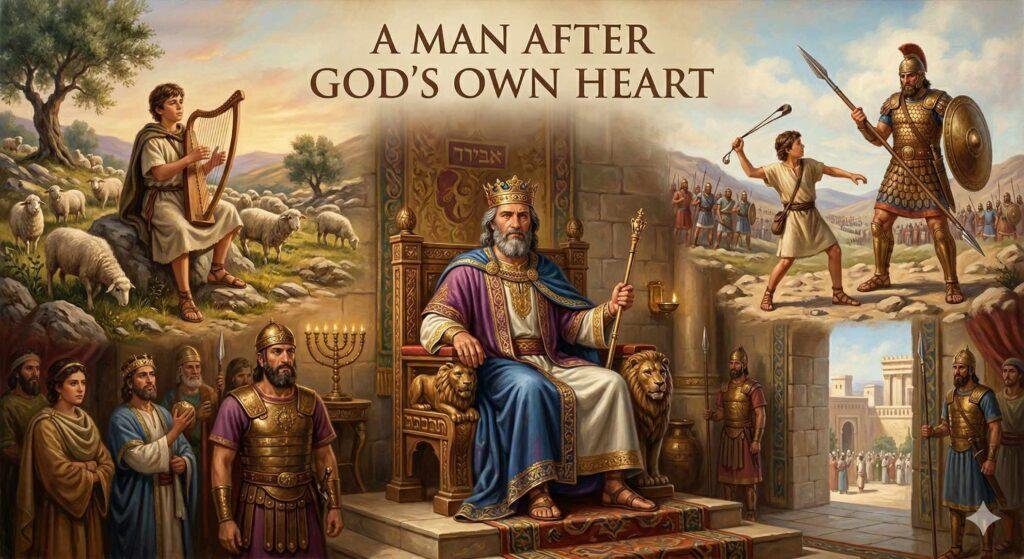


When we look through the pages of Scripture, there are plenty of heroes. But only one person receives a very specific, incredibly profound title from God Himself: “A man after His own heart.”
We first hear this in 1 Samuel 13:14. King Saul had just disobeyed God, and the prophet Samuel delivers a sobering message:
1 Samuel 13:14 14 But now your kingdom shall not continue. The Lord has sought for Himself a man after His own heart, and the Lord has commanded him to be commander over His people, because you have not kept what the Lord commanded you.”
That man, of course, was David.
Paul refers to this passage in Acts 13:22;
Acts 13:21-22 21 And afterward they asked for a king; so God gave them Saul the son of Kish, a man of the tribe of Benjamin, for forty years.
22 And when He had removed him, He raised up for them David as king, to whom also He gave testimony and said, ‘I have found David the son of Jesse, a man after My own heart, who will do all My will.’
Some background on Israel’s kings. Samuel the prophet was the spiritual leader in Israel, and all Israel looked to him. But Israel was concerned about who Samuel’s successor would be – his sons were not godly men. They were corrupt. So in 1 Samuel 8, the elders came to Samuel, and asked for a king so they could be like other nations.
1 Samuel 8:6-7 6 But the thing displeased Samuel when they said, “Give us a king to judge us.” So Samuel prayed to the Lord.
7 And the Lord said to Samuel, “Heed the voice of the people in all that they say to you; for they have not rejected you, but they have rejected Me, that I should not reign over them.
So Samuel warned the people about what a king would do: he would take their sons and daughters to serve in his court, he would tax them, and take the best of the fields and livestock.
1 Samuel 8:18-20 18 And you will cry out in that day because of your king whom you have chosen for yourselves, and the Lord will not hear you in that day.”
19 Nevertheless the people refused to obey the voice of Samuel; and they said, “No, but we will have a king over us,
20 that we also may be like all the nations, and that our king may judge us and go out before us and fight our battles.”
Israel was unique in that God was their ruler. But they wanted to be like the other nations, and have someone they could see to rule over them. So God decided to grant them their request, and chose someone that looked good.
1 Samuel 9:1-2 1 There was a man of Benjamin whose name was Kish the son of Abiel, the son of Zeror, the son of Bechorath, the son of Aphiah, a Benjamite, a mighty man of power.
2 And he had a choice and handsome son whose name was Saul. There was not a more handsome person than he among the children of Israel. From his shoulders upward he was taller than any of the people.
Saul had the outward appearance of someone Israel would want as king. But he didn’t have the inward qualities. In his heart, he was an insecure person. He was too concerned about what people thought. And that was his downfall.
So this time when Saul was to be replaced, God was going to choose the man that He wanted – a man after His own heart.
God’s Choice
But what does it actually mean to be a man or a woman after God’s own heart? It’s tempting to think it’s just another way of saying, “God really likes you,” or that it means you are flawlessly holy. But if we know anything about David’s story, we know he was far from perfect.
Having a heart after God means you are a person actively pursuing Him—seeking to find out and do the things that please Him. It’s a posture of the soul. Despite his many faults, this relentless pursuit sums up the passion of David’s life.
If we want to cultivate that same posture in our own lives, we can look to four defining characteristics of David:
1. He Was a Worshipper Before He Was a Ruler
Long before David wore a crown, he held a shepherd’s staff. In the lonely, quiet hills of Judea, with only sheep for an audience, David was singing to the Lord. He cultivated a private history with God before he ever had a public platform.
His skill as a musician and his reputation for carrying God’s presence are what originally brought him into the royal court to minister to Saul when he was tormented by a spirit. Throughout his life, he poured his soul out in The Psalms, giving us a vocabulary for our own joy, sorrow, and praise.
- For Us: Being after God’s heart starts in the secret place. It means choosing to worship and seek Him in our daily, mundane routines, not just when others are watching.
2. He Was a Person of Immense Faith
David didn’t just sing about God; he fiercely trusted Him. We see this most famously in his words when he came against Goliath. While an entire army of trained soldiers cowered in fear, a young David observed the taunts of the giant and said in 1 Samuel 17:34-36,
1 Samuel 17:34-36 34 But David said to Saul, “Your servant used to keep his father’s sheep, and when a lion or a bear came and took a lamb out of the flock,
35 I went out after it and struck it, and delivered the lamb from its mouth; and when it arose against me, I caught it by its beard, and struck and killed it.
36 Your servant has killed both lion and bear; and this uncircumcised Philistine will be like one of them, seeing he has defied the armies of the living God.”
Then in the words he spoke to Goliath:
1 Samuel 17:45-46 45 Then David said to the Philistine, “You come to me with a sword, with a spear, and with a javelin. But I come to you in the name of the Lord of hosts, the God of the armies of Israel, whom you have defied.
46 This day the Lord will deliver you into my hand, and I will strike you and take your head from you. And this day I will give the carcasses of the camp of the Philistines to the birds of the air and the wild beasts of the earth, that all the earth may know that there is a God in Israel.
David knew that his victory didn’t depend on his own strength, but on the faithfulness of God. Hebrews 11:6 reminds us, “Without faith it is impossible to please Him.” Faith deeply pleases God because it demonstrates our complete reliance on Him.
- For Us: Cultivating a heart for God means trusting Him when the odds are stacked against us. It means looking at the “giants” in our lives and choosing to believe that God is bigger.
3. He Actively Sought God’s Ways
One of the recurring themes in David’s life is his habit of “inquiring of the Lord.” Whether he was facing a battle, a transition, or a crisis, David continually paused to ask God for direction. He wasn’t just interested in God’s blessings; he was interested in God’s ways. He wanted his steps to align with Heaven’s blueprint.
- For Us: We live in a culture that tells us to follow our own truth and forge our own path. A person after God’s heart pauses and says, “Lord, what do You want? Lead me in Your truth and teach me.”
4. He Modeled True, Broken Repentance
We can’t talk about David without talking about his failures. He had some serious faults and committed some devastating sins—adultery and murder among them. So how could a murderer and adulterer still hold the title of “a man after God’s own heart”?
The answer lies in how he responded to his sin. When the prophet Nathan confronted him, David didn’t make excuses, blame others, or try to justify his actions. He broke. He fully repented. We read his agonizing, beautiful prayer of repentance in Psalm 51:
Psalms 51:10-11 10 Create in me a clean heart, O God, And renew a steadfast spirit within me.
11 Do not cast me away from Your presence, And do not take Your Holy Spirit from me.
He recognized that his sin was ultimately against God, and he valued God’s presence more than his own pride.
- For Us: You don’t have to be perfect to be a man or woman after God’s heart, but you do have to be repentant. When we mess up, we don’t run away from God in shame; we run to Him in brokenness, trusting His mercy.
The Passion of a Lifetime
David’s life is a brilliant, messy, beautiful testament to God’s grace. To be a man or woman after God’s own heart doesn’t require a flawless record. It requires a worshipping spirit, an active faith, a desire for God’s ways, and a quickness to repent. It is the lifelong pursuit of the One who first pursued us.