


Mark 6:1-6 1 Then He went out from there and came to His own country, and His disciples followed Him.
2 And when the Sabbath had come, He began to teach in the synagogue. And many hearing Him were astonished, saying, “Where did this Man get these things? And what wisdom is this which is given to Him, that such mighty works are performed by His hands!
3 Is this not the carpenter, the Son of Mary, and brother of James, Joses, Judas, and Simon? And are not His sisters here with us?” And they were offended at Him.
4 But Jesus said to them, “A prophet is not without honor except in his own country, among his own relatives, and in his own house.”
5 Now He could do no mighty work there, except that He laid His hands on a few sick people and healed them.
6 And He marveled because of their unbelief. Then He went about the villages in a circuit, teaching.
Why was Jesus hindered here? Why was He not able to do any mighty miracles? The text says that He laid His hand on a few sick folk and healed them, and the implication was that these were minor ailments. There was no blind seeing, or deaf hearing, or lame walking.
So it looked like at least a few people had some faith in Jesus. But look at what the rest were saying: “Where did this guy come from that He’s doing such things? We know who He is – He’s that neighborhood carpenter. I knew Him when He was a little kid.” It says that they were offended at Him.
It wasn’t that no one had faith to be healed – they had heard the stories of His miracles, and He demonstrated healing in front of them. But they had no faith in the person of Jesus.
Jesus marveled at their unbelief. It actually surprised Him.
There is a difference between doubt and unbelief. Doubt is when you want to believe, but you are struggling. We’ve all had “but what if it doesn’t work?” doubts in our lives. God can work through that.
A couple of Biblical examples where someone had doubt, yet they still got answers:
The father who brought his demonized son to the disciples, but they couldn’t help him.
Mark 9:20-24 20 Then they brought him to Him. And when he saw Him, immediately the spirit convulsed him, and he fell on the ground and wallowed, foaming at the mouth.
21 So He asked his father, “How long has this been happening to him?” And he said, “From childhood.
22 And often he has thrown him both into the fire and into the water to destroy him. But if You can do anything, have compassion on us and help us.”
23 Jesus said to him, “If you can believe, all things are possible to him who believes.”
24 Immediately the father of the child cried out and said with tears, “Lord, I believe; help my unbelief!”
Another example is the leper who came to Jesus.
Matthew 8:2 And behold, a leper came and worshiped Him, saying, “Lord, if You are willing, You can make me clean.”
The leper obviously had faith and trust in the person of Jesus. It says he worshipped Him, meaning he fell down on his knees before Him. He had faith that Jesus was able to heal. His area of doubt? He didn’t know if Jesus was willing. Remember, in those days lepers were ostracized. According to the Law, he should have stood afar off and shouted “Unclean!” and not approached. He was one of those who wondered, “If it be Thy will.” Jesus of course was willing.
Neither of these two men had perfect faith; they had doubts, but they still got their answer.
Unpersuadableness
Hebrews 3:12 Beware, brethren, lest there be in any of you an evil heart of unbelief in departing from the living God;
Hebrews 3:18-19 18 And to whom did He swear that they would not enter His rest, but to those who did not obey?
19 So we see that they could not enter in because of unbelief.
The subject of Hebrews chapter 3 is the 10 spies that brought back the “evil report” after they spied out the land.
Numbers 13:27-29 27 Then they told him, and said: “We went to the land where you sent us. It truly flows with milk and honey, and this is its fruit.
28 Nevertheless the people who dwell in the land are strong; the cities are fortified and very large; moreover we saw the descendants of Anak there.
29 The Amalekites dwell in the land of the South; the Hittites, the Jebusites, and the Amorites dwell in the mountains; and the Canaanites dwell by the sea and along the banks of the Jordan.”
At this point, they are doing exactly what they were sent to do: scope out the land, find out about the people, where the cities were, and even that there were giants in the land.
Caleb and Joshua: “Let’s go, we can take ‘em”.
It’s what they said next that was wrong. They were fearful and doubted their ability to defeat these foes. Then they chose words that would discourage others as well. That’s why it was an “evil report”.
They were offended by the faith of Joshua and Caleb. So they had to justify their fear.
Numbers 13:31-33 31 But the men who had gone up with him said, “We are not able to go up against the people, for they are stronger than we.”
32 And they gave the children of Israel a bad report of the land which they had spied out, saying, “The land through which we have gone as spies is a land that devours its inhabitants, and all the people whom we saw in it are men of great stature.
33 There we saw the giants (the descendants of Anak came from the giants); and we were like grasshoppers in our own sight, and so we were in their sight.”
Their words had the desired effect on the congregation. They all lifted up their voices and wept and wished they had already died in the wilderness (fear is irrational. They were afraid of being killed, so they wished they were already dead).
Joshua and Caleb attempted to quiet the people and remind them of how big the God Who was with them was. But this just made them angry, and the people wanted to stone them – to shut them up, because they were exposing their unbelief and cowardice.
The root of the problem? Despite all they had seen, they still did not trust God. Forty years later, Moses gave an account of this event:
Deuteronomy 1:25-31 25 They also took some of the fruit of the land in their hands and brought it down to us; and they brought back word to us, saying, ‘It is a good land which the Lord our God is giving us.’
26 “Nevertheless you would not go up, but rebelled against the command of the Lord your God;
27 and you complained in your tents, and said, ‘Because the Lord hates us, He has brought us out of the land of Egypt to deliver us into the hand of the Amorites, to destroy us.
28 Where can we go up? Our brethren have discouraged our hearts, saying, “The people are greater and taller than we; the cities are great and fortified up to heaven; moreover we have seen the sons of the Anakim there.” ‘
29 Then I said to you, ‘Do not be terrified, or afraid of them.
30 The Lord your God, who goes before you, He will fight for you, according to all He did for you in Egypt before your eyes,
31 and in the wilderness where you saw how the Lord your God carried you, as a man carries his son, in all the way that you went until you came to this place.’
In Hebrews 3:19, where it says the Israelites could not enter the promised Land because of their unbelief, the word actually means unpersuadableness. They were not persuaded of God’s love for them; therefore they had no trust in His promise that they would be able to take the land.
Unbelief is still belief – it’s just believing the wrong thing.
Atheists believe there is no God. Yet why are many of them offended by those who do believe in something they do not believe exists? It’s not just that they don’t believe in God; they become anti-God.
Doubt and Disqualified?
Does doubt disqualify from answers? If you look at these verses, it seems like it.
Mark 11:22-24 22 So Jesus answered and said to them, “Have faith in God.
23 For assuredly, I say to you, whoever says to this mountain, ‘Be removed and be cast into the sea,’ and does not doubt in his heart, but believes that those things he says will be done, he will have whatever he says.
24 Therefore I say to you, whatever things you ask when you pray, believe that you receive them, and you will have them.
James 1:5-8 5 If any of you lacks wisdom, let him ask of God, who gives to all liberally and without reproach, and it will be given to him.
6 But let him ask in faith, with no doubting, for he who doubts is like a wave of the sea driven and tossed by the wind.
7 For let not that man suppose that he will receive anything from the Lord;
8 he is a double-minded man, unstable in all his ways.
However, having doubts at one point does not forever disqualify you from receiving answers.
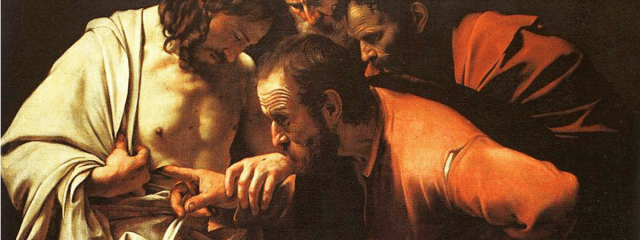
We have the story of Doubting Thomas in John 20:24-29. When the other disciples tell him that the Lord appeared to them, his reply was “Unless I see… I will not believe”. That sounds like unbelief/unpersuadableness to me. But what happened next time when Jesus appeared to the disciples, and Thomas was there?
John 20:27-29 27 Then He said to Thomas, “Reach your finger here, and look at My hands; and reach your hand here, and put it into My side. Do not be unbelieving, but believing.“
28 And Thomas answered and said to Him, “My Lord and my God!”
29 Jesus said to him, “Thomas, because you have seen Me, you have believed. Blessed are those who have not seen and yet have believed.”
It’s a shame that Thomas gained the moniker of “The Doubter” because he didn’t remain one. He went on to minister in India, and there is a story about him that appears in oral tradition and in songs around Palayur, one of the cities where he preached. It could just be a legend, but it’s a great story nonetheless.
According to the legend, Thomas encountered Hindu Brahmins performing a ritual by throwing water upward as an offering to the sun. He challenged them, saying their god was not accepting the offering since the water fell back. Thomas then invoked the Trinity, made the sign of the cross, and threw water into the air, where it remained suspended until he finished preaching. This miracle reportedly led to the conversion of several Brahmins and Jews in Palayur.
Abraham
Abraham is lifted up as a prime example of faith.
Romans 4:19-21 19 And not being weak in faith, he did not consider his own body, already dead (since he was about a hundred years old), and the deadness of Sarah’s womb.
20 He did not waver at the promise of God through unbelief, but was strengthened in faith, giving glory to God,
21 and being fully convinced that what He had promised He was also able to perform.
Look at this description: he didn’t consider the circumstances…he did not waver…he was fully convinced. Yet, when you look at his life, he definitely did waver and have doubts.
Genesis 17:15-18 15 Then God said to Abraham, “As for Sarai your wife, you shall not call her name Sarai, but Sarah shall be her name.
16 And I will bless her and also give you a son by her; then I will bless her, and she shall be a mother of nations; kings of peoples shall be from her.”
17 Then Abraham fell on his face and laughed, and said in his heart, “Shall a child be born to a man who is one hundred years old? And shall Sarah, who is ninety years old, bear a child?”
18 And Abraham said to God, “Oh, that Ishmael might live before You!”
Abraham fell on his face and laughed at the ridiculousness of God’s promise.
Sarah had some difficulty with it also.
Genesis 18:10-12 10 And He said, “I will certainly return to you according to the time of life, and behold, Sarah your wife shall have a son.” (Sarah was listening in the tent door which was behind him.)
11 Now Abraham and Sarah were old, well advanced in age; and Sarah had passed the age of childbearing.
12 Therefore Sarah laughed within herself, saying, “After I have grown old, shall I have pleasure, my lord being old also?”
At least Sarah just laughed within herself; she didn’t fall on her face as Abraham did. And she is listed in Hebrews 11, along with Abraham, as one of the heroes of faith.
Hebrews 11:11 By faith Sarah herself also received strength to conceive seed, and she bore a child when she was past the age, because she judged Him faithful who had promised.
Both Abraham and Sarah had a journey to get to faith. The Bible describes them as they ended up, not according to their struggles on the way. (For more, see Judging Him Faithful)
Doubt is not an indictment, but an invitation. – Steve Backlund, Igniting Hope Ministries
How is doubt an invitation? It should not be a declaration of failure, but an indication of where you need to grow.
When determining the truth of something where there are differing opinions, it’s useful to look at the two extremes. Because the truth is usually somewhere in the middle.
- Doubt once and you are forever disqualified
- What you believe doesn’t matter; God will still get you the answer
The key is that we should grow in faith, as Abraham did. Moving from doubt to faith is a progression. Wavering back and forth – if you sit in doubt for a shorter time than you did before, you’ve made progress.
It doesn’t matter where you start; it matters where you end up.
I think we can safely eliminate the first extreme, that doubting once forever disqualifies you from receiving an answer.
But what about the second extreme? Does faith matter?
Yes it does. James 1 says that if you ask for wisdom and then doubt that God will give it to you, don’t expect to receive it. While you are doubting and wavering, it will hinder and delay the answer.
David Encouraged Himself in the Lord
Typically, what we will see is that when we are hit with a trying circumstance, we may be in anxiety and doubt at first. But like David, we encourage ourselves in the Lord, and basically talk ourselves into trust. And the time when we are anxious becomes less and less.
1 Samuel 30:6 KJV 6 And David was greatly distressed; for the people spake of stoning him, because the soul of all the people was grieved, every man for his sons and for his daughters: but David encouraged himself in the LORD his God.
How do we encourage ourselves in the Lord? David would talk to himself, like he was giving a pep talk.
Psalms 42:5 5 Why are you cast down, O my soul? And why are you disquieted within me? Hope in God, for I shall yet praise Him For the help of His countenance.
We remind ourselves of God’s promise. We remind God of His promise. It’s not that He forgets, but saying, “God, Your word says…” and quoting the promise will build our faith. He doesn’t need to change; we do.
Here’s another important point: Just because you have a thought of doubt in your head – “Why did this happen? What am I going to do?” – doesn’t mean you are in unbelief. What matters is if we act on that thought.
Not every thought in your head comes from you. The sources of thoughts are: from yourself, things you see and hear in the world around you, from the devil, and from God/the Holy Spirit.
Think of it this way: thoughts present themselves to you, but it matters what you do with them.
I like how the KJV words these verses:
Matthew 6:25 KJV Therefore I say unto you, Take no thought for your life, what ye shall eat, or what ye shall drink; nor yet for your body, what ye shall put on. Is not the life more than meat, and the body than raiment?
Matthew 6:31 KJV Therefore take no thought, saying, What shall we eat? or, What shall we drink? or, Wherewithal shall we be clothed?
Other translations will render it as “Don’t be anxious”, but I really like the concept in the KJV of taking the thought. A thought presents itself to you, but it will not have an effect unless you take it.
How do you take a thought? Vs. 31 shows us that you take a thought – you make it your own – when you speak it. Don’t vocalize it! Or better yet, speak what God says, His promise.
Here’s what we are doing:
2 Corinthians 10:3-5 3 For though we walk in the flesh, we do not war according to the flesh.
4 For the weapons of our warfare are not carnal but mighty in God for pulling down strongholds,
5 casting down arguments and every high thing that exalts itself against the knowledge of God, bringing every thought into captivity to the obedience of Christ,
Steve Backlund has a very effective way to deal with lies that contradict what God says – he laughs at them. He even wrote a book about it called “Let’s Just Laugh at That”.

The key is to externalize the thought, as if someone else were talking and you were just hearing it. “The devil says you’re not going to have enough money to pay your bills this month.” Ha Ha Ha! “Nobody knows or cares about your ministry. You have zero influence.” Hee Hee Hee!
Paul uses this technique of externalization in Romans 7. I believe in this chapter Paul is describing what his life was like as a Pharisee living under the Law. “I don’t do what I want to, and end up doing the very thing I hate”. But in two places, he separates himself as the one who wants to do good, from the sin that makes him do what he doesn’t want to.
Romans 7:17 But now, it is no longer I who do it, but sin that dwells in me.
Romans 7:20 Now if I do what I will not to do, it is no longer I who do it, but sin that dwells in me.
Good Word!!