
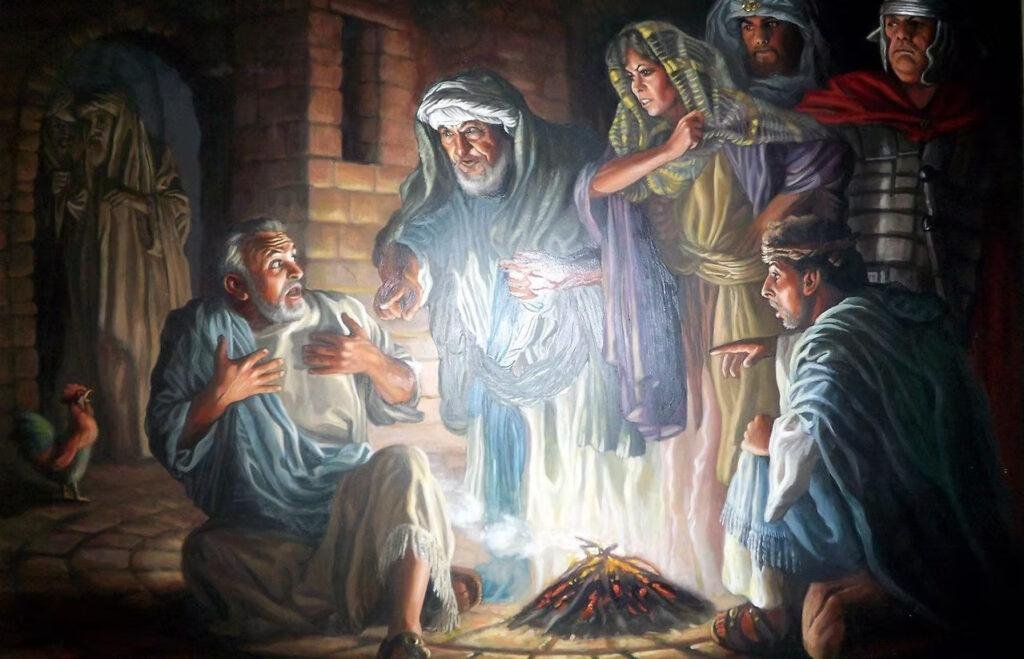


I was reading through some passages regarding Peter and noticed some things about his betrayal of denying Christ, and then his reinstatement.
Mark 8:27-33 27 Now Jesus and His disciples went out to the towns of Caesarea Philippi; and on the road He asked His disciples, saying to them, “Who do men say that I am?”
28 So they answered, “John the Baptist; but some say, Elijah; and others, one of the prophets.”
29 He said to them, “But who do you say that I am?” Peter answered and said to Him, “You are the Christ.”
30 Then He strictly warned them that they should tell no one about Him.
31 And He began to teach them that the Son of Man must suffer many things, and be rejected by the elders and chief priests and scribes, and be killed, and after three days rise again.
32 He spoke this word openly. And Peter took Him aside and began to rebuke Him.
33 But when He had turned around and looked at His disciples, He rebuked Peter, saying, “Get behind Me, Satan! For you are not mindful of the things of God, but the things of men.”
The first thing we can see is how fast we can switch from hearing from God with revelation, to listening to the voice of the world. Simon receives the revelation that Jesus is the Christ, the Son of the Living God, and Jesus calls him blessed and gives him a new name.
And a couple of sentences after that, Jesus is rebuking Peter. Now I don’t think Jesus was calling Peter “Satan” – what He was rebuking was the force that was influencing Peter and his words. Peter was being mindful of the things of men – which we could say was human reasoning.
From Peter’s viewpoint at that time (which was not God’s viewpoint), in today’s language we could say that Peter was attempting to “correct Jesus’ negative confession”; it says that Peter took Jesus aside and began to rebuke Him: “Now Jesus, You shouldn’t be talking like that. You’re the Messiah, and the Messiah is to be the victor and King”.
The disciples did not understand that it was God’s plan for the Messiah to die for their sins, that He was the Lamb of sacrifice. It was only after His resurrection that they began to believe these things.
So correcting a negative confession is a good thing, when that negative confession is contrary to the Word of God. But that was the Word made flesh that was speaking those things – you don’t “correct” what God says.
Peter’s Denial Predicted
Peter’s denial that he even knew Jesus is looked at as an act of cowardice on his part. But what were the events leading up to that?
Luke 22:31-34 31 And the Lord said, “Simon, Simon! Indeed, Satan has asked for you, that he may sift you as wheat.
32 But I have prayed for you, that your faith should not fail; and when you have returned to Me, strengthen your brethren.”
33 But he said to Him, “Lord, I am ready to go with You, both to prison and to death.”
34 Then He said, “I tell you, Peter, the rooster shall not crow this day before you will deny three times that you know Me.”
What would Peter do when he heard those words? He was serious when he said he was willing to die for Jesus. He would form a resolve that he would protect Jesus at all costs. Unfortunately, he was still “minding the things of men” when he thought that way. Even though Jesus told them on multiple occasions what was going to happen, the disciples could not accept it. In Matthew, He comes right out and says what is going to happen.
Matthew 26:2 2 “You know that after two days is the Passover, and the Son of Man will be delivered up to be crucified.”
At the Last Supper, Jesus once again speaks of being betrayed. He even identifies it as Judas to John. Matthew speaks about it.
Matthew 26:21-25 21 Now as they were eating, He said, “Assuredly, I say to you, one of you will betray Me.”
22 And they were exceedingly sorrowful, and each of them began to say to Him, “Lord, is it I?”
23 He answered and said, “He who dipped his hand with Me in the dish will betray Me.
24 The Son of Man indeed goes just as it is written of Him, but woe to that man by whom the Son of Man is betrayed! It would have been good for that man if he had not been born.”
25 Then Judas, who was betraying Him, answered and said, “Rabbi, is it I?” He said to him, “You have said it.”
Someone pointed out a detail I hadn’t seen before. After Jesus says that one of the disciples will betray Him, each of them ask in turn, “Lord, is it I?”. But when it comes to Judas, he asks, “Rabbi, is it I?” He didn’t call Jesus Lord.
Resisting in the Garden
All four gospels report on the story of when Jesus was taken captive in the Garden of Gethsemane. Each give different details.
Matthew 26:47-54 47 And while He was still speaking, behold, Judas, one of the twelve, with a great multitude with swords and clubs, came from the chief priests and elders of the people.
48 Now His betrayer had given them a sign, saying, “Whomever I kiss, He is the One; seize Him.”
49 Immediately he went up to Jesus and said, “Greetings, Rabbi!” and kissed Him.
50 But Jesus said to him, “Friend, why have you come?” Then they came and laid hands on Jesus and took Him.
51 And suddenly, one of those who were with Jesus stretched out his hand and drew his sword, struck the servant of the high priest, and cut off his ear.
52 But Jesus said to him, “Put your sword in its place, for all who take the sword will perish by the sword.
53 Or do you think that I cannot now pray to My Father, and He will provide Me with more than twelve legions of angels?
54 How then could the Scriptures be fulfilled, that it must happen thus?”
Mark 14:43-50 43 And immediately, while He was still speaking, Judas, one of the twelve, with a great multitude with swords and clubs, came from the chief priests and the scribes and the elders.
44 Now His betrayer had given them a signal, saying, “Whomever I kiss, He is the One; seize Him and lead Him away safely.”
45 As soon as He had come, immediately he went up to Him and said to Him, “Rabbi, Rabbi!” and kissed Him.
46 Then they laid their hands on Him and took Him.
47 And one of those who stood by drew his sword and struck the servant of the high priest, and cut off his ear.
48 Then Jesus answered and said to them, “Have you come out, as against a robber, with swords and clubs to take Me?
49 I was daily with you in the temple teaching, and you did not seize Me. But the Scriptures must be fulfilled.”
50 Then they all forsook Him and fled.
Luke 22:47-51 47 And while He was still speaking, behold, a multitude; and he who was called Judas, one of the twelve, went before them and drew near to Jesus to kiss Him.
48 But Jesus said to him, “Judas, are you betraying the Son of Man with a kiss?”
49 When those around Him saw what was going to happen, they said to Him, “Lord, shall we strike with the sword?”
50 And one of them struck the servant of the high priest and cut off his right ear.
51 But Jesus answered and said, “Permit even this.” And He touched his ear and healed him.
They all mention the person cutting off the servant’s ear.
Matthew gives the detail that Jesus said He could call on 12 legions of angels to deliver Him.
Mark adds the detail that all the disciples forsook Him and fled.
Luke says that Jesus picked up the severed ear, put it back on the servant’s head, and healed him.
Matthew, Mark, and Luke mention that “one of the disciples” cuts off the servant’s ear, but don’t mention who it was.
Then we have John.
John 18:3-11 3 Then Judas, having received a detachment of troops, and officers from the chief priests and Pharisees, came there with lanterns, torches, and weapons.
4 Jesus therefore, knowing all things that would come upon Him, went forward and said to them, “Whom are you seeking?”
5 They answered Him, “Jesus of Nazareth.” Jesus said to them, “I am He.” And Judas, who betrayed Him, also stood with them.
6 Now when He said to them, “I am He,” they drew back and fell to the ground.
7 Then He asked them again, “Whom are you seeking?” And they said, “Jesus of Nazareth.”
8 Jesus answered, “I have told you that I am He. Therefore, if you seek Me, let these go their way,”
9 that the saying might be fulfilled which He spoke, “Of those whom You gave Me I have lost none.”
10 Then Simon Peter, having a sword, drew it and struck the high priest’s servant, and cut off his right ear. The servant’s name was Malchus.
11 So Jesus said to Peter, “Put your sword into the sheath. Shall I not drink the cup which My Father has given Me?”
John: “It was Peter!”
John also gives the fascinating detail in vs. 6, that when Jesus said “I am He”, the crowd “drew back and fell to the ground”. Jesus’ reply was related to the name that God gave Moses at the burning bush: I AM THAT I AM. There was such power in Jesus’ declaration that it knocked the mob over.
Vs. 8 also gives Jesus’ intention: He was to be arrested, but all the other disciples were to go free. It was actually His will that “they all forsook Him and fled”.
And then there was Peter.
Remember we said that when Jesus foretold Peter’s denial, that Peter would resolve within himself to protect Jesus, and even die if necessary. He is about to act on that resolve.
It says that it was an armed multitude that came to arrest Jesus – a lot of people. There would have been Temple Guard – trained soldiers – among them. Peter has a sword. Where did he get it? Jesus told him to have one.
Luke 22:36-38 36 Then He said to them, “But now, he who has a money bag, let him take it, and likewise a knapsack; and he who has no sword, let him sell his garment and buy one.
37 For I say to you that this which is written must still be accomplished in Me: ‘And He was numbered with the transgressors.’ For the things concerning Me have an end.”
38 So they said, “Lord, look, here are two swords.” And He said to them, “It is enough.”
In Luke 22:49 it says “they” ask, but we know it was Peter – “Lord, shall we strike with the sword?” But he doesn’t wait for an answer. He charges that armed multitude, alone. He is fully intending to die for Jesus if need be, and his attacking the crowd proves it.
But he is a fisherman, not a soldier, and all he manages to do is cut off someone’s ear. John even knew who he was and names him – Malchus.
Jesus quickly (and probably forcefully) tells Peter to put that sword away, because He doesn’t want Peter arrested or maybe killed. He further defuses the situation in Luke by healing Malchus of the damage Peter had done.
Denying Three Times
All the disciples fled, but two of them followed the crowd to see what was happening – Peter and John.
The crowd brought Jesus to Annas’ house. Annas was the father in law of Caiphas, the high priest. But Annas himself had been high priest previously. We learn another interesting tidbit about John – he was known to the high priest, both Annas and Caiphas. John wasn’t just some unknown fisherman in backwards Galilee. He had connections with the highest spiritual officials in Israel.
John 18:12-16 12 Then the detachment of troops and the captain and the officers of the Jews arrested Jesus and bound Him.
13 And they led Him away to Annas first, for he was the father-in-law of Caiaphas who was high priest that year.
14 Now it was Caiaphas who advised the Jews that it was expedient that one man should die for the people.
15 And Simon Peter followed Jesus, and so did another disciple. Now that disciple was known to the high priest, and went with Jesus into the courtyard of the high priest.
16 But Peter stood at the door outside. Then the other disciple, who was known to the high priest, went out and spoke to her who kept the door, and brought Peter in.
And it was this servant girl who “kept the door” that first identified Peter.
John 18:17-18 17 Then the servant girl who kept the door said to Peter, “You are not also one of this Man’s disciples, are you?” He said, “I am not.”
18 Now the servants and officers who had made a fire of coals stood there, for it was cold, and they warmed themselves. And Peter stood with them and warmed himself.
First denial. Peter moved away from the door to the fire they had going in the courtyard.
John 18:25 25 Now Simon Peter stood and warmed himself. Therefore they said to him, “You are not also one of His disciples, are you?” He denied it and said, “I am not!”
Second denial. In a parallel passage, it says he cursed.
John 18:26-27 26 One of the servants of the high priest, a relative of him whose ear Peter cut off, said, “Did I not see you in the garden with Him?”
27 Peter then denied again; and immediately a rooster crowed.
Third denial, and the rooster crowed.
One of the parallel passages says that Jesus turned and looked at Peter when the rooster crowed. Can you imagine how Peter felt? He would be absolutely devastated. He turned from the one who rushed the crowd to protect Jesus at his own peril, to the one who denied he even knew Jesus. And Jesus knew it would happen.
He went out and wept bitterly.
Peter is at a crossroads here. He could be absorbed in the condemnation he felt, and remain separated from the other disciples out of shame, or he could decide that his love for Jesus was greater than the shame for his sin.
Jesus predicted not only Peter’s denial, but his turning back.
Luke 22:31-32 31 And the Lord said, “Simon, Simon! Indeed, Satan has asked for you, that he may sift you as wheat.
32 But I have prayed for you, that your faith should not fail; and when you have returned to Me, strengthen your brethren.”
So Peter gathered together with the other disciples – in secret, for fear of the Jews. What were they thinking? What were they saying? I’m sure by then they had recalled that Jesus had told them explicitly that He would be arrested, put on trial, and crucified. These were words they were not willing to face before. “He said it would happen, and it did”. And then another one would say, “But He also said, ‘On the third day I will rise from the dead’”. So they had that hope, which might have been slight, before them. Praying, wondering what they should do next.
After His Resurrection
Mark 16:4-7 4 But when they looked up, they saw that the stone had been rolled away–for it was very large.
5 And entering the tomb, they saw a young man clothed in a long white robe sitting on the right side; and they were alarmed.
6 But he said to them, “Do not be alarmed. You seek Jesus of Nazareth, who was crucified. He is risen! He is not here. See the place where they laid Him.
7 But go, tell His disciples–and Peter–that He is going before you into Galilee; there you will see Him, as He said to you.”
Notice the angel explicitly says to include Peter.
I asked AI (Google Gemini) to list all the appearances of Jesus to people between His resurrection and His final ascension. These are the witnesses to His resurrection. There are more than I realized:
Here is the traditional chronological harmony of Jesus’ post-resurrection appearances across the Gospels, Acts, and Paul’s letters:
Mary Magdalene
Resurrection Morning
Location: Near the tomb in Jerusalem
Scripture: John 20:11–18; Mark 16:9–11
Jesus appears first to Mary Magdalene after Peter and John inspect the empty tomb. She initially mistakes Him for the gardener until He speaks her name.
The Other Women
Resurrection Morning
Location: Jerusalem, returning from the tomb
Scripture: Matthew 28:8–10
Appears to Mary the mother of James, Salome, and Joanna as they run to report the empty tomb to the disciples. They grasp His feet and worship Him.
Simon Peter (Cephas)
Resurrection Day
Location: Jerusalem area
Scripture: Luke 24:34; 1 Corinthians 15:5
A private appearance to Peter prior to the evening gathering. Details of the conversation are not recorded, but the disciples confirm: “The Lord has risen indeed, and has appeared to Simon!”
Two Disciples on the Road to Emmaus
Resurrection Afternoon
Location: Road to Emmaus (~7 miles from Jerusalem)
Scripture: Luke 24:13–35; Mark 16:12–13
Jesus walks alongside Cleopas and another disciple, explaining Old Testament prophecies concerning the Messiah. Their eyes are opened when He breaks bread with them.
Ten Apostles (Without Thomas)
Resurrection Evening
Location: Upper Room, Jerusalem
Scripture: Luke 24:36–49; John 20:19–23; Mark 16:14
Appears behind locked doors, shows His hands and side, eats a piece of broiled fish to demonstrate His physical body, and breathes the Holy Spirit on them.
Eleven Apostles (With Thomas)
Eight Days Later
Location: Upper Room, Jerusalem
Scripture: John 20:24–29
Jesus appears again behind locked doors. He invites Thomas to touch His wounds, prompting Thomas’ confession: “My Lord and my God!”
Seven Disciples by the Sea
During the 40 Days
Location: Sea of Galilee (Tiberias)
Scripture: John 21:1–23
Directs a miraculous catch of 153 fish from the shore, cooks breakfast for Peter, Thomas, Nathanael, James, John, and two others, and formally reinstates Peter three times.
Over 500 Brethren & the Eleven
During the 40 Days
Location: Mountain in Galilee
Scripture: Matthew 28:16–20; 1 Corinthians 15:6
The largest gathered appearance where Jesus delivers the Great Commission, declaring that all authority in heaven and on earth has been given to Him.
James (Brother of Jesus)
During the 40 Days
Location: Unknown (likely Galilee or Jerusalem)
Scripture: 1 Corinthians 15:7
A private appearance to His earthly brother James, who was previously skeptical (John 7:5), leading to James becoming a primary leader in the Jerusalem church.
The Apostles at the Ascension
Day 40
Location: Mount of Olives near Bethany
Scripture: Luke 24:50–53; Acts 1:4–12; Mark 16:19
Gives final instructions regarding the promise of the Holy Spirit, blesses the disciples, and ascends visibly into the clouds.
Post-Ascension Visions (Epistles & Acts)
After Pentecost
Location: Various
Scripture: Acts 7:55–56 (Stephen); Acts 9:1–6, 1 Corinthians 15:8 (Saul/Paul on the Damascus Road); Revelation 1:12–18 (John on Patmos)
Restoration
John 21:1-7 1 After these things Jesus showed Himself again to the disciples at the Sea of Tiberias, and in this way He showed Himself:
2 Simon Peter, Thomas called the Twin, Nathanael of Cana in Galilee, the sons of Zebedee, and two others of His disciples were together.
3 Simon Peter said to them, “I am going fishing.” They said to him, “We are going with you also.” They went out and immediately got into the boat, and that night they caught nothing.
4 But when the morning had now come, Jesus stood on the shore; yet the disciples did not know that it was Jesus.
5 Then Jesus said to them, “Children, have you any food?” They answered Him, “No.”
6 And He said to them, “Cast the net on the right side of the boat, and you will find some.” So they cast, and now they were not able to draw it in because of the multitude of fish.
7 Therefore that disciple whom Jesus loved said to Peter, “It is the Lord!” Now when Simon Peter heard that it was the Lord, he put on his outer garment (for he had removed it), and plunged into the sea.
It’s kind of like, “Well, what do we do now?” So Peter says he is going fishing, returning to something familiar, his normal routine. But they catch nothing.
Jesus, afar off on the shore, tells them to throw the nets on the other side of the boat – and they get a huge catch! It was a repeat of the miracle that Jesus did in front of Simon (before he was Peter) that was the occasion of his original calling to be a fisher of men. Jesus was reminding Peter of this moment. The calling was still there.
In John 21:15-18, Jesus asks Peter three times if Peter loved him – once for each of his denials.
It’s interesting what the Greek has in this passage. Now Jesus and Peter were not speaking in Greek, they would be speaking in Aramaic.
vs. 15 “Simon, Son of Jonas, do you agapao Me?” “Yes, Lord, You know that I phileo You.”
Vs. 16 Again Jesus asks, “Simon, do you agapao Me?” And again Simon Peter answers, “You know that I phileo You.”
Vs.17 Now Jesus asks, “Simon, do you phileo Me?” And Simon answers, somewhat grieved, “Lord, You know that I phileo You.”
The Amplified brings out the difference between these different Greek words for love.
John 21:15 AMP 15 When they had eaten, Jesus said to Simon Peter, Simon, son of John, do you love Me more than these [others do—with reasoning, intentional, spiritual devotion, as one loves the Father]? He said to Him, Yes, Lord, You know that I love You [that I have deep, instinctive, personal affection for You, as for a close friend]. He said to him, Feed My lambs.
I had always wondered why Peter would not answer Jesus whether He loved Him in the same way that Jesus asked. So I studied it out, again with the help of AI, and found out some interesting things.
First of all, they would not have been speaking Greek, with the words agape and phileo. Why is the New Testament in Greek? That was the most widely used second language at the time. I.e., if a person’s native language was not Greek, Greek was most likely their second language. Greek was chosen to be able to reach the most people. In modern day, it would be English. (Here’s an interesting fact – which nation has the most English speaking people? It’s not the U.S. The answer is India.)
So my first question was, if Jesus and Peter were not speaking Greek and were most likely speaking Aramaic, does Aramaic have the same distinction between the two types of love as the Greek?
[AI]: 1. Aramaic: How Does It Express Love?
If Jesus and Peter were speaking Aramaic—which was the primary spoken language among first-century Jewish people in Judea and Galilee—they would not have had direct equivalents to the Greek agapao and phileo distinctions.
In Aramaic, the primary verb for “to love” is rḥm (רחם / racham) or ḥbb (חבב / chav).
- Racham (רחם): Carries a deep, compassionate, tender love. It shares a root with the word for “womb” (rechem), emphasizing deep, visceral care or mercy.
Chav (חבב): Means to love, hold dear, or express affection/friendship.
Did Aramaic distinguish levels like Greek?
Not in the same structural way. Aramaic does not use different words to separate “willful/unconditional love” (agape) from “affectionate/brotherly friendship” (philia). If Jesus and Peter spoke in Aramaic, Jesus likely used racham or chav with tonal shifts or subtle word variation, but the dynamic of switching between “unconditional commitment” and “friendship” is distinctively Greek.
(Note: The Syriac Peshitta—the ancient Aramaic translation of the New Testament—uses the root rḥm for all three of Jesus’ questions and Peter’s answers, relying on context rather than distinct vocabulary to carry the narrative).
I then asked a similar question about the Hebrew words for love, in case they were speaking Hebrew:
[AI] 2. Hebrew: How Does It Express Love?
In Ancient/Biblical Hebrew, the vocabulary for love is similarly unified:
- Ahav (אָהַב / ‘ahav): The primary Hebrew word for “love”. It is extremely broad—covering God’s covenant love for Israel, a father’s love for a son, romantic love, and friendship (like David and Jonathan).
Racham (רָחַם): Deep mercy, tender compassion, or emotional affection.
Chesed (חֶסֶד): Frequently translated as “lovingkindness,” “covenant loyalty,” or “unfailing mercy.” While it functions as a noun for steadfast love, it is more about faithful commitment than affection alone.
In Hebrew, you would not swap between two everyday verbs to contrast “higher spiritual love” versus “brotherly friendship” in the way classical Greek allows. One word (‘ahav) handles almost everything, with modifiers or context adding the nuance.
Origin of the use of Agape
I then asked some questions about the usage of agape and phileo in secular Greek. And this gets really interesting: in secular Greek, agape never meant some higher form of love. Christian writers adopted it and made it to mean that. Here’s what AI said about it:
1. How Were Agape and Phileo Used in Secular Greek?
In classical and Hellenistic secular Greek (prior to or outside of the New Testament), the dynamic between these two words was almost the opposite of how modern sermons often describe them.
Phileo (and its noun form, Philia)
In secular Greek, phileo was the rich, warm, highly prized word for deep affection, emotional connection, and personal commitment.
- Ancient philosophers like Plato and Aristotle wrote extensively on philia as one of the highest human virtues—representing deep, reciprocal soul-friendship, loyalty, and fond affection.
- It was a very strong, desirable, and emotionally charged word.
Agape (and its verb form, Agapao)
In secular Greek, agapao was actually a rather plain, neutral, and generic verb.
- It often meant simply “to prefer,” “to be fond of,” “to welcome,” or “to be content with”.
- A person could agapao their spouse, but they could also agapao a good meal or a particular career path.
- Because it lacked the deep emotional intensity of phileo or the passionate drive of eros, secular writers used agapao as a useful, color-neutral “catch-all” word for liking or preferring something.
2. Why Did Early Christians Adopt Agape?
If phileo was the prized word for deep love in secular Greek, why did the New Testament writers elevate agape?
The Septuagint (LXX) Influence
When Jewish scholars translated the Hebrew Bible into Greek in the 3rd–2nd century BC (the Septuagint), they needed a Greek word to translate the broad Hebrew word for love, ‘ahav (אָהַב).
- Because phileo carried specific pagan philosophical connotations and eros was tied to physical/romantic passion, the translators chose the relatively “blank canvas” word agapao to carry the weight of God’s covenant love.
The Early Church’s Theological Shift
By the time Paul wrote his epistles (AD 48–62) and John wrote his Gospel (AD 90s), early Christians had transformed agape into a technical theological term. They took a standard, ordinary word and filled it with new meaning based on the cross: a love that is defined by action, choice, and self-sacrifice, rather than emotional warmth or mutual benefit.
So, by the time Paul wrote 1 Corinthians 13 (“Agape is patient, agape is kind…”) or John wrote 1 John 4 (“God is agape“), the Christian community had already given agape its distinct, self-giving definition.
3. Did New Testament Writers Keep Them Strictly Separate?
Even though agape became a favorite Christian word, New Testament writers (including John and Paul) did not treat agape and phileo as mutually exclusive or rigidly hierarchical.
| Context in the New Testament | Word Used |
| “The Father loves (phileo) the Son…” | John 5:20 |
| “The Father Himself loves (phileo) you…” | John 16:27 |
| “If anyone does not love (phileo) the Lord…” | 1 Corinthians 16:22 |
| Men loving (agapao) darkness rather than light | John 3:19 |
| Demas loving (agapao) this present worldly age | 2 Timothy 4:10 |
Notice that the Father’s love for Jesus and believers is described using phileo, while a person’s sinful devotion to darkness or the world is described using agapao. This shows that agape was not automatically “godly/unconditional” and phileo was not automatically “lesser/flawed.”
Summary
- Before the Church: In secular Greek, phileo was the warm, esteemed word for deep affection/friendship, while agape was a generic, colorless word for preferring or liking something.
- The Christian Transformation: The early Church—starting with the Septuagint and continuing through Paul and John—adopted agape and infused it with the specific meaning of God’s self-sacrificing love.
- In John 21: The shift between agape and phileo in Jesus and Peter’s dialogue is a subtlety of Greek writing style, but it relies on a Christian redefinition of those words, not a pre-existing distinction from secular Greek literature.
Conclusion
What does Peter’s example say to us?
Have you ever done something so wrong you’ve felt it disqualifies you from the original destiny God had for you?
We have another example with King David. He committed adultery, then plotted the murder of the woman’s husband. Yet he was restored (see A Man After God’s Own Heart). The key to Peter’s and David’s restoration was that they truly repented.
Maybe you have not denied you know Jesus in front of other people, or committed adultery and murdered. But all of us have probably done something (or maybe not done something) that has caused us shame and to draw back from God, because how could He ever trust us again?
Here’s a point – God is not surprised when we sin. That big failure – He knew you would do what you did or not do before He saved you and called you – yet He did so anyway.
What do you do after the failure? Repent. That may mean changing the direction back to the path you were originally on, that you deviated from.
God will restore.