


A Part To Play
In almost every one of God’s promises, there is a part for God to play and a part for us to play. Let’s take a look at this in one of the most fundamental of God’s promises: salvation.
Salvation has been purchased for the entire human race through the sacrifice of Jesus: His death, burial, and resurrection.
2 Corinthians 5:17-21 17 Therefore, if anyone is in Christ, he is a new creation; old things have passed away; behold, all things have become new.
18 Now all things are of God, who has reconciled us to Himself through Jesus Christ, and has given us the ministry of reconciliation,
19 that is, that God was in Christ reconciling the world to Himself, not imputing their trespasses to them, and has committed to us the word of reconciliation.
20 Now then, we are ambassadors for Christ, as though God were pleading through us: we implore you on Christ’s behalf, be reconciled to God.
21 For He made Him who knew no sin to be sin for us, that we might become the righteousness of God in Him.
Notice in vs. 19 who it says was reconciled to God: the world. Not just the Christians. And it says that He did not impute their trespasses against them.
God has already done what He needed to in order to obtain and procure our salvation. Jesus has already died for our sins, He has already been raised from the dead.
It is God’s will that everybody be saved.
1 Timothy 2:1-4 1 Therefore I exhort first of all that supplications, prayers, intercessions, and giving of thanks be made for all men,
2 for kings and all who are in authority, that we may lead a quiet and peaceable life in all godliness and reverence.
3 For this is good and acceptable in the sight of God our Savior,
4 who desires all men to be saved and to come to the knowledge of the truth.
Is everyone going to be saved, then? No. Why not? Because we have a part to play also.
John 3:16-17 16 For God so loved the world that He gave His only begotten Son [God’s part], that whoever believes in Him [our part] should not perish but have everlasting life.
17 For God did not send His Son into the world to condemn the world, but that the world through Him might be saved.
It’s like a chess game (not that God views life as a game or that we should), but that God has made His move and now He is waiting on us to make ours.
What would you think of someone begging and praying, “Oh God, please save me. Oh God, please forgive my sins!” You ask them, “Are you saved?” “No, I’m just waiting on God to save me. He knows I need to be saved, and if it’s His will, He’ll save me.”
Would you try to correct that person’s thinking? Would you tell them that God has already done what He needs to save them, and they just need to receive what He has already done? “But I don’t know if it’s His will to save me.” Wouldn’t you show them the scriptures, “whosoever that believes in Him…” “God desires all men to be saved….”?
“Well, I don’t know about that. I just believe that if He wants me to be saved, He’ll save me.”
Will that person be saved? Not as long as they keep believing that way. There has to be a point where they believe. And if they died lost and went to hell, would it be proper to say, “I guess it wasn’t God’s will to save them”. No! Did it have anything to do with God’s will for them? No! This person was waiting for God to make a move that He already made. It’s your move!
I used this illustration with salvation because just about everyone could agree and be on the same page that God is waiting on us (at least in these days. There was a time in history where Calvinism with its strong belief in predestination was prevalent).
But the same is true in just about every other area of God’s promises!
Way back in the day, before the internet (80’s and earlier), they had these catalog stores like Service Merchandising and Consumers Club. The “showroom” didn’t have merchandise, just catalogs. The catalogs showed what you could get. You’d fill out a form with the catalog numbers, go to the cashier and pay, and they would give you a claim ticket. Then you’d go to the pickup line and wait. In back there was a big warehouse where they kept all the merchandise, but you couldn’t see it. You’d present your claim ticket, and someone in the back would fill your order. In the fancier places, this was done automatically, you just had to wait in line until your order was complete.
If they were busy, you’d have to be patient. Eventually your order would come down the conveyor belt, a person working the pickup line would check the items against your ticket to make sure they were all there, and off you’d go.
What if you got tired of waiting and went home? What if, after you paid, you never went to the pickup line? “Oh, they know what I want, I believe they’ll just get it to me”.
The Bible is like our catalog in that it shows us what is available. Now don’t get me wrong, I’m not trying to portray God as a Santa Claus or a vending machine where you pick what you want and ignore the rest.
Initiators of a Miracle
Will God never do things for people without them being the instigators? Of course He will. We have an excellent example of that with the man at the pool of Bethesda.
In John 5, we have the story of the Pool of Bethesda, where an angel would come down and splash in the water, and whoever got in the pool first was healed of whatever malady they had. Does God do such things? Yes!
One man who had been paralyzed for 38 years was by the pool, but every time the water was stirred, someone else got in first because he had no one to help him, and he was too slow in his paralyzed state.
Then one day Jesus shows up, and asks him a question: “Do you want to be made well?” Now isn’t the answer to that obvious? Yet it seemed hopeless – “I have no man.” But he did have just enough hope that brought him to the pool day after day.
The paralyzed man didn’t need the pool – Jesus was going to be his “man” to help him. “Rise, take up your bed, and walk.” And he did!
But what was interesting is that Jesus left the pool, even though there was a lot of other sick people there. He didn’t heal anybody else. He had an assignment from the Father to go to that specific man. Jesus initiated the miracle.
But then we have other examples where a person initiated a miracle.
Letting paralytic through the roof
In Luke 5:17-26, we have a paralytic who had four friends that were going to help get him before Jesus because they knew if they did he would be healed. When they got to the house, the place was standing room only. They couldn’t get in through the door or windows. So they decided to go to the roof. Some houses in Israel had flat roofs with stairs leading up to them that could be used like a patio. But it says that they started tearing the tiles off the roof, so that doesn’t sound like a patio.
Vs 20: When he saw their faith, He said to the paralytic, “Man, your sins are forgiven you.”
Why would Jesus say that? It was a common opinion amongst the Jews that if someone suffered from a debilitating disease or condition, it was because of sin. Remember in John 9:2 when the disciples asked Jesus, “Who sinned, this man or his parents, that he was born blind?” Maybe the paralyzed man believed it was because of sin.
The Pharisees that were there took issue with that. But Jesus said He was going to demonstrate that He had the authority to forgive sins by healing the man – because both took divine power and authority.
But here is the question – who initiated the miracle? Whose idea was it? It was the paralytic and his friends.
Woman with the issue of blood.
In Mark 5 we have a woman with an issue of blood (basically it was like she was on her period) – for 12 years. She had heard of Jesus, and said to herself, “If I can just tough the hem of His garment, I will be healed”. Then she acted on it by going out in the crowd, even though under the Law she was unclean and it was unlawful for her to do so.
She touched the hem, and was probably on her knees at this point since the hem was low to the ground – and was instantly healed. Jesus had little to do with it other than being a vessel of the power of God. He told the woman, “Your faith has made you whole”.
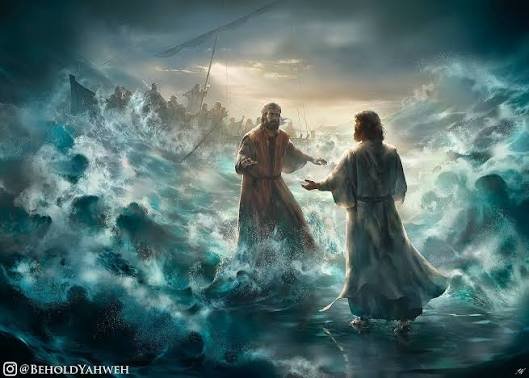
Peter walking on water
We know this story. Jesus sent the disciples ahead, telling them to go to the other side of Galilee, and went up to pray. But on the way across, a violent wind came up, and they were in danger of sinking. This had happened before, but that time Jesus was with them, taking a nap, and they woke Him and He spoke to the storm and calmed it.
I bet the disciples were saying, “Oh, if only Jesus were here!” In the meantime, up on the mountain, the Holy Spirit told Jesus, “Your boys are in trouble”. He wouldn’t be able to see them, it was pitch dark, so He got it by revelation.
So Jesus comes to them walking on the water – in answer to their prayer. And they thought it was a ghost and were terrified! There was a superstition amongst the fishermen that if you saw a ghost while out on the water, you were about to join him.
“Don’t be afraid, it’s Me!”
Good old impetuous Peter – “Lord, if it is You, bid me come to you on the water!” What is Jesus going to do – say, “No Peter, it’s not Me, don’t come!”. So Jesus says, “Come!”
Peter stepped out of the boat, and walked on the water. Now if you were to measure Peter’s faith at that moment, he was operating in Great Faith. He was taking a huge risk, because of his trust in Jesus’ word. Now we know that he faltered when he took his eyes off of Jesus and started looking at the circumstances of the wind and waves (because you know you can’t walk on water when it’s windy). But as he began to sink, Jesus grabbed him, pulled him up, and they both walked on the water back to the boat.
Who initiated that miracle? Whose idea was it for Peter to walk on water? It was Peter!
There are more examples of people initiating a miracle
- The Syro-Phoenician woman whose daughter was vexed by a demon, and wouldn’t take no for an answer
- The leper that believed Jesus could heal him, if it was His will
- The centurion who said Jesus just needed to speak a word and his servant would be healed
- Blind Bartimaeus who cried out, “Jesus, Son of David, have mercy on me!”
Without Him you can do nothing.
Jesus only did what He saw the Father do and only said what He heard the Father say. That was the secret to His power.
We can be bold and step out and take risks when we have a word and a promise of God to back it up.
But what happens when you have a general promise from God, but not a specific leading?
That’s what presumption is: assuming you’re going to get a certain result when you perform a certain action, not based on the word of God or a specific leading.
Examples: Healing. There are many, many promises of God for healing, so we can know that it is God’s will to heal us.
But, to stop taking your medication unless you have specific leading from the Holy Spirit can be presumption.
You need a new car, so you decide to give away your old one and then God will give you a new one. That is no guarantee that you are going to get a new car the next day!
There are examples of these things where people have stopped taking their medication, or given something away, and God healed and provided – but they were led to do these things.
“But if God did it for them, he’ll do it for me!” Absolutely! Hearing testimonies of what God has done for others inspires us that God can do the same for us.
The problem comes when you try to copy someone else’s leading – what they did to act on their faith.
Peter walked on the water because Jesus told him, “Come”. What if one of the other disciples in the boat saw Peter walking on the water and decided if he could do it they could also, and jumped out of the boat? Would they walk on the water? Probably not, they’d sink. But if they called out, “Jesus, can I come too?” and He said “Come!” – then they could.
A story from my own life: I was saved when I was 19, during the summer between my first and second year of college at U.C. Berkeley. The next year, maybe a year and a half later, my girlfriend and I (saved about a month before me) along with some other friends got it into our heads that that we were going to have a ministry where we go to churches and “speak the word of the Lord” to them. Not invited, just show up. Of course it was not right and any good pastor would not allow strangers to come in and start prophesying what their church needed to do. We were young, not quite baby Christian but still childish, and Satan was taking advantage of our zeal and hunger to be used and misguided it.
I dropped out of school. I went up for prayer during a special conference our home church was having, and told them I’d quit school and needed a job and believed I’d have one within a week. I thought I was walking in faith. The guest minister who prayed for me said, “Oh, you’re forcing God’s hand, right?” He did pray for me, and also prayed for God’s guidance.
That prayer request I had was presumptuous. We were out of God’s will, and I was trying to dictate what God was going to do, thinking I was in faith.
We did get out of that mess. In a meeting at our church (not Sunday am), the pastor said, “There are some young people here that have gotten out from under their parent’s authority and God can’t use them until they get it right” (I don’t remember the exact words, this was in 1976, but that was the gist). This church believed in the gifts of the Spirit, but the pastor wasn’t accustomed to giving words like that. We knew he was talking about us. We went up and talked with him afterwards, and got some instruction. I did go back to school and finished my degree.
When to Take Risks
We don’t want to be in the ditch on either side of the road. Some people are so fearful of being in presumption that they won’t do anything unless they hear the audible voice of God. That’s one extreme. The other side is to go off and do things without consulting with the Lord. And that is the important point here: consulting with the Lord.
Proverbs 3:5-6 5 Trust in the Lord with all your heart, And lean not on your own understanding;
6 In all your ways acknowledge Him, And He shall direct your paths.
Acknowledge Him – or another way to say it, is in all your ways – whatever you are doing – include Him. Get His opinion on it.
There are some types of risks you can take because they are part of the Great Commission. Should I witness to this person? Should I pray for this person’s healing? We’ve already been commanded to do that sort of thing, so go ahead.
But when a particular course of action is life altering – you better get God’s wisdom on it.
James 4:13-16 13 Come now, you who say, “Today or tomorrow we will go to such and such a city, spend a year there, buy and sell, and make a profit”;
14 whereas you do not know what will happen tomorrow. For what is your life? It is even a vapor that appears for a little time and then vanishes away.
15 Instead you ought to say, “If the Lord wills, we shall live and do this or that.”
16 But now you boast in your arrogance. All such boasting is evil.
Now this person is talking about relocating to a different city and starting a business. That’s pretty life altering! But James is saying, “you don’t really know what is going to happen. You need to find out if it’s in God’s will or not.” He even says to go with your own plans without consulting the Lord is arrogant and evil.
It’s not that God gets mad at you for not consulting Him, but He knows the future and what pitfalls you may fall into. Maybe your general plan is good, but the city where you wanted to go to is not. Or maybe the timing isn’t right. He wants you to succeed, when you are following His leading.
David, before going into battle, would always “inquire of the Lord.”
If you want some excellent instruction in decision making, I recommend Fully Convinced: The Art of Decision Making by Steve Backlund.